

School Wide Positive Behaviour Support
Our Purpose:
At West Northam Primary School, our students learn to persevere and achieve their best. We foster a sense of belonging and support our students to respect, care and contribute to a positive school community.
Our whole-school approach brings together Positive Behaviour Support (PBS) and the Berry Street Education Model (BSEM).
What is Positive Behaviour Support?
Positive Behaviour Support is a proactive, evidence-based approach focused on preventing behaviour concerns by explicitly teaching students the skills and behaviours they need to succeed.
Just as we teach literacy and numeracy, we teach expected behaviours through clear explanations, modelling, practice, feedback and recognition. When behaviour errors occur, they are viewed as opportunities to re-teach expectations, support regulation and help students make more positive choices.
Our approach aims to create:
- safe, inclusive and engaging learning environments
- clear and consistent expectations across the school
- a common language used by students, staff and families
- positive and respectful relationships
- predictable routines and responses
- students who can recognise their needs, regulate their emotions and return to learning.
Our PBS Team
The WNPS PBS Team supports the ongoing implementation and sustainability of Positive Behaviour Support across the school.
The team works to:
- strengthen a positive and inclusive school culture
- promote consistent expectations and practices
- support a shared language across the school
- analyse behaviour and engagement data
- develop and review school-wide systems
- coordinate the explicit teaching of expected behaviours
- gather feedback from staff, students and families
- recognise strengths and identify areas for improvement.
Our decisions are evidence-based, responsive to the needs of the WNPS community and regularly reviewed. Through collaboration and consistent practice, we aim to ensure every student feels that they belong, is treated with respect and is supported to learn.
Our Behaviour Expectations
Our three whole-school values are Belong • Respect • Learn, and underneath each value are the expected behaviours related to that value.
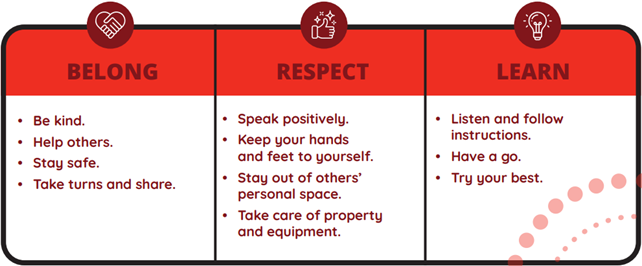
These expectations are described in the WNPS Behaviour Matrix and apply across classrooms, playgrounds and other school settings.
A focus behaviour is selected from the matrix and explicitly taught across the school. Teachers regularly revisit the focus behaviour through classroom discussions, PBS lessons, daily circles, modelling and opportunities for students to practise.
Staff use positive, clear and consistent language when teaching, prompting and reinforcing expectations.
Recognising Positive Behaviour
Positive behaviour is strengthened when students receive immediate and specific feedback that clearly identifies what they have done well.
At WNPS, students may be recognised through:
Deadlies and Recognition Boards
Students receive Deadlies when they demonstrate our expected behaviours. When giving a Deadly, staff name the behaviour being recognised, for example, “Thank you for taking turns and sharing.”
Deadlies are placed in the class Rocket Assembly raffle box. Students are also encouraged to notice and recognise peers who demonstrate the focus behaviour.
In Weeks 3, 6 and 9 of each term, two Deadlies are drawn from each class’s raffle box at Rocket Assembly, and the students drawn choose a prize.
Good Standing
Students who maintain Good Standing by following the expectations in the WNPS Behaviour Matrix receive additional playtime before lunch each day.
Star of the Week
Teachers, education assistants and Aboriginal and Islander Education Officers recognise students who have demonstrated significant effort or gone above and beyond expectations, by awarding a Star of the Week card. Stars of the Week are announced on Fridays and participate in a special recognition activity.
Supporting Regulation and Readiness to Learn
Through the Berry Street Education Model, students are taught to recognise their emotions, understand their readiness to learn and use strategies that help them self-regulate and re-engage.behaviours.
Across WNPS, students experience a range of supportive practices, including:
Circles
Classrooms use check-in, check-out, preparation, response and learning circles. Circles help build relationships, create a sense of belonging, prepare students for learning and provide opportunities for reflection and restorative conversations.
Positive Primers and Brain Breaks
Positive primers are short activities used to create a positive start to learning. Brain breaks are strategically used during lessons to help students renew their focus, regulate their energy, and remain engaged in their learning.
Ready-to-Learn Scales
Ready-to-Learn Scales help students identify and communicate how ready they are to participate in learning. They are used as supportive, self-reflection tools, not to judge or evaluate students.
Students are explicitly taught a range of short, practical strategies they can use when they are not yet ready to learn. Staff support students to select an appropriate strategy, reflect on whether it helped and return to learning.
Consistent, Predictable Routines
Consistent, predictable rhythms, routines and transitions reduce uncertainty and help students feel safe. While practices may look different across year levels, students experience consistent expectations, calm adult responses and clear guidance throughout the school.
Responding to Behaviour: Four Ways
At WNPS, staff use the Four Ways approach to respond to low- and mid-level behaviours:
1. Prompt positive and expected behaviour.
2. Monitor low-level behaviour using discreet, low-key responses.
3. Coach students who are dysregulated or need support to solve a problem.
4. Signal behaviour that is disrupting learning or affecting others.
Staff responses are calm, consistent, respectful and appropriate to the individual student and situation.
Restorative practices are used to help students understand the impact of their behaviour, repair harm and make more positive choices in the future.
A Tiered Approach to Support
WNPS uses a three-tiered approach to behaviour, engagement and wellbeing:
- Tier 1 – Universal support: Consistent expectations, teaching, routines, recognition and regulation strategies provided to all students.
- Tier 2 – Targeted support: Additional strategies and support for students who require more assistance.
- Tier 3 – Individual support: Individualised planning developed with the student, family, teaching team and relevant support staff.
The tiers describe the level of support provided. All students access Tier 1 universal support, while some students may require additional Tier 2 or Tier 3 support. This reflects our commitment to equity by recognising that students may need different levels of support to experience success.